

 |
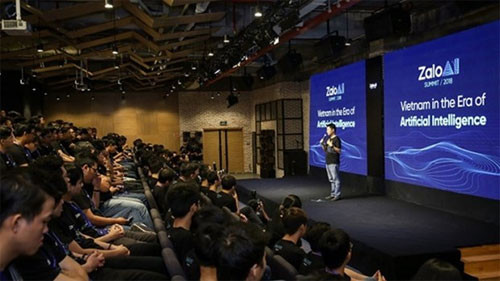
Ki-Ki, the first Vietnamese chatbot, was presented at Zalo AI Summit 2018 in late
December 2018, where Vietnam’s AI community showed optimism
about the development of AI (Photo: brandsvietnam.com)
Although Vietnam is on the back foot in terms of AI and faces huge challenges,
including a weak technology sector and lack of human resources, the country has
managed to build a vibrant AI ecosystem and set up a plan for research and
development with breakthrough strategies.
At the same time, many organisations and businesses in Vietnam are now trying to
keep up with their foreign rivals by building technical skills to shape raw
ideas into fully serviceable and effective AI applications.
Viettel Cyberspace Center (VTCC), established in 2014, has focused research on
AI. VTCC.AI focuses on providing three services for speech processing, including
TTS (Text to Speech), Speech to Text, and Voice Wake-up. The products can be
applied to a variety of platforms, such as reading newspapers, books, or in
automated customer care systems.
Zalo AI plans to develop applications such as Zalo Brain and Zalo Assistant.
At the Zalo AI Summit conference held at the end of 2018, the Ki-Ki virtual
assistant was officially launched with the ability to recognise the voice of
Vietnamese people and answer with northern, central and southern accents.
ELSA is an English pronunciation training application founded by Van Dinh Hong
Vu. The application uses AI to recognise voice accuracy and help users improve
their skills.
AI is also providing strong support in the field of transport. Self-driving cars
with AI can automatically avoid people or obstacles, and are being used in the
Ecopark urban area in Hanoi. In HCM City, AI has been used to help monitor
traffic cameras and adjust traffic lights.
In health, AI is also being employed to improve quality, efficiency, overcome
risks, medical incidents and reduce hospital overcrowding.
The 115 People's Hospital and Gia An 115 Hospital in HCM City are the first two
hospitals in Vietnam to apply Rapid Artificial Intelligence software in stroke
diagnosis and treatment.
According to Ngo Quoc Hung, Creative Director of COTAI – the centre for talents
in AI – who has been teaching AI to students of the Le Hong Phong High School
for the Gifted in HCM City, AI is no longer unfamiliar to high school students.
In their eyes, AI is now an interesting subject which offers useful information
and applications.
“In several more years, Vietnam will have many good engineers in AI and the
number of start-ups in AI will increase,” Hung said.
Tu Nguyen, managing director of VietA.I Community, who has been working for 10
years in emerging technologies, said there were 25 workers in the international
payment division of HSBC five years ago.
Nowadays, when the work volume is five times higher, the division only needs
three workers, because a big workload is now undertaken by computers.
Also according to the expert, at Minh Long II Technical Ceramics factory in Binh
Duong province, 70 percent of work is being undertaken by robots.
“This shows that AI has penetrated into all areas in Vietnam, raising the need
of developing the labour force in the field of AI,” he said.
Long way to go
Dang Hoang Vu, Science Director of the FPT Corporation, said that 2020 will be
the year of "popularising AI".
And while Vietnam has a lot of potential for AI development, most AI start-ups
are still at a very early stage of development.
The country’s AI start-ups are still facing many difficulties when resources are
limited, training is inadequate and many high-skilled workers choose to work
overseas.
According to the 2018 Vietnam AI Landscape Report published by Nexus Frontier
Tech initiative RubikAI, almost 60 percent of AI companies in Vietnam have been
in business for less than two years, and only 34 percent have raised more than
US$200,000 from external sources.
Also according to the report, two other big challenges for Vietnam are a
shortage of talent and the ability to approach data.
Vu said that in order to develop faster than its competitors, the Government
needs to have policies to socialise AI and encourage businesses to use
artificial intelligence in business activities.
He also emphasised the importance of effective connection among the community
and major businesses, among the components of the AI ecosystem.
Source: VNA