

 |
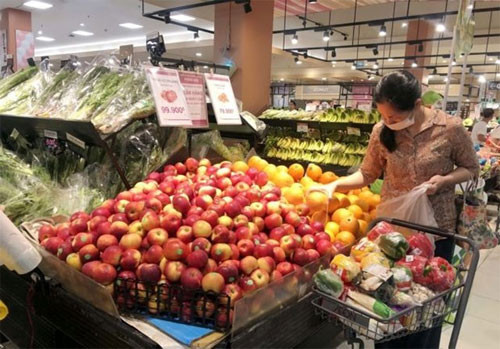
A woman shops for fresh fruits at AEON Long Bien Supermarket in Hanoi.
(Photo: VNA)
Tuan said the National Assembly had set a target of consumer price index (CPI)
growth at about 4 percent for this year.
“The most important thing is to control the prices on the domestic market
according to the mandate from the central administration to the local level.
Another important factor is providing information about the market performance
as well as policies on controlling prices issued by the Government,” Tuan said.
The state management of prices had gradually implemented and promptly adjusted
prices of a number of important goods and services in the domestic economy or
goods according to the market demand.
In addition, the role and duties of the State in management, administration and
price stabilisation had also been clarified through macroeconomic mechanisms and
solutions that are suitable to requirements in the economic development process.
Therefore, the representative of the department said that it would closely
monitor price fluctuations on the domestic market, especially essential goods
and services, to promptly propose solutions on ensuring the balance between
supply and demand, especially goods with a shortage of supply due to natural
disasters, pandemic and high demand of goods before, during and after Tet.
In addition, the Ministry of Finance had recommended that ministries and sectors
continue to closely follow the market price situation for specific management.
For instance, the Ministry of Industry and Trade needed to work closely with the
MoF in managing the petroleum price based on the market factors and the
Petroleum Price Stabilisation Fund.
For electricity, it was necessary to carefully evaluate factors affecting the
electricity price, thereby having a suitable price management scenario.
Tuan said this year, the prices of essential goods were expected to be
unchanged. Meanwhile, the prices of some goods were very unpredictable due to
impacts from negative factors for prices, such as fuel products with complicated
fluctuations.
He also forecast that storms and floods, as well as the COVID-19 pandemic,
were affecting the supply and the market.
The business situation of some services such as accommodation, tourism,
entertainment and aviation was forecast to face many difficulties.
According to the General Statistics Office (GSO), Vietnam’s consumer price index
(CPI) in the first four months grew 0.89 percent year-on-year, the lowest growth
rate since 2016.
The index in April was down 0.04 percent against the previous month while up to
2.7 percent year on year.
Compared to the previous month, a downturn was seen in the prices of four out of
11 main groups of goods and services, with housing and construction materials
taking the lead (0.43 percent), followed by post and telecommunication services;
food and catering services, among others.
Source: VNA